
Meaning
Heavy Claw
Length
9 metres (30 ft)
Classification
Theropoda,
Spinosauridae Stromer 1915
Baryonyx sp
Locations
Known from the Wessex Formation, so try Brighstone, especially near Barnes High (remember the vertebra…), although teeth are found at Grange Chine..
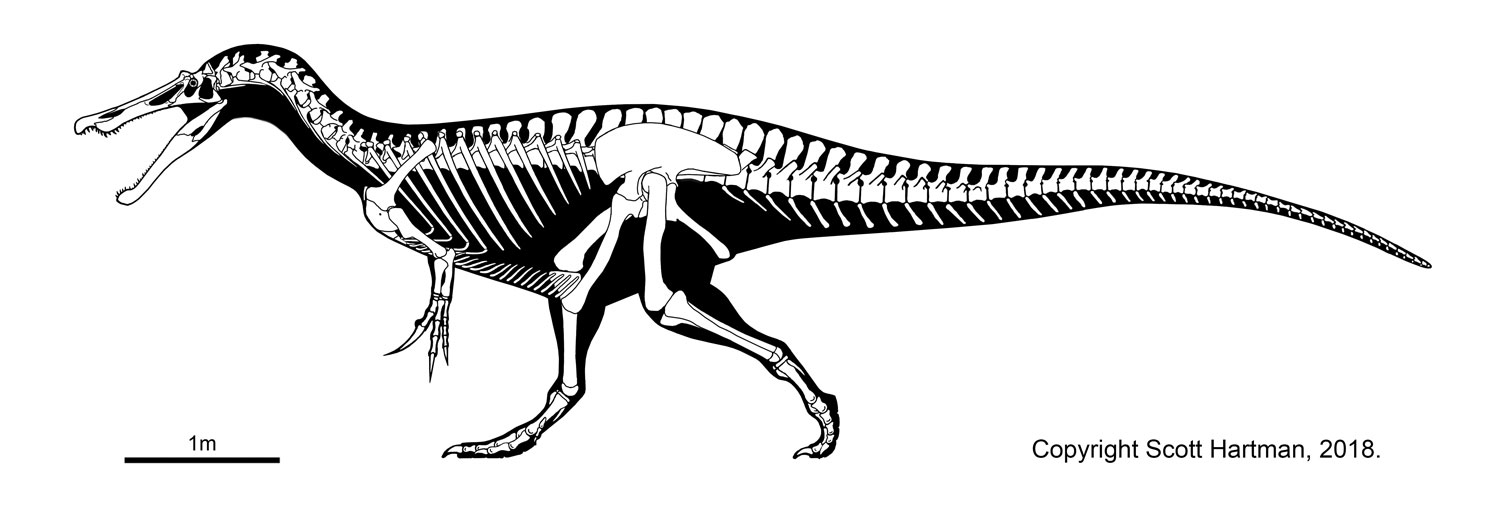
Baryonyx was a theropod dinosaur, and is assumed to have been a fish eater, waiting on riverbanks, resting on its forelimbs until a large fish such as Scheenstia (which was found in the belly of the type specimen in Surrey) swims past, then scoops it up with its large thumb claw. There were also Iguanodon bones in the stomach, so it may have attacked or scavenged them too. It walked on two legs.
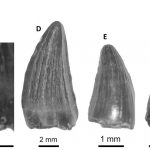
Baryonyx fossils are rare, with only fragments and teeth known from the island. Baryonyx teeth are unusual for theropod teeth as they have very fine serrations, with at least 7 per millimetre, are slightly fluted on their crowns and are only slightly compressed labio-lingually. These teeth are, so I’m told, actually quite common on the Isle of Wight, so keep your eyes peeled!
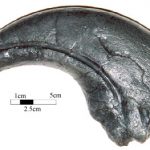
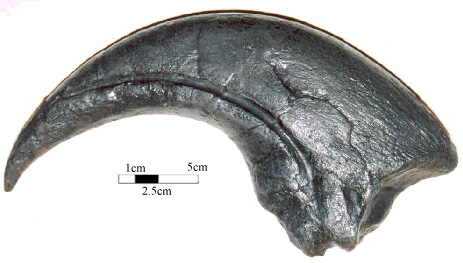
Another feature is the large thumb claw, nearly 30 cm (1 foot) long. This has never been found on the Isle of Wight, but is the feature that made Baryonyx famous, although some years back a small theropod claw found by Martin Simpson was identified as being part of a Baryonyx manual ungual.
A manual phalange, believed to be the very one that supported the massive claw, was claimed by the Museum of Isle of Wight Geology (now Dinosaur Isle) in 1998 from the collection of Carisbrooke Castle Museum.
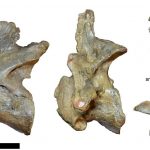
A Baryonyx vertebra turned up near Barnes High fairly recently – it was due to be on show at Dinosaur Farm Museum, but a cast was displayed at the SVPCA in 2004, as evidence for the synonymity of Baryonyx and Suchomimus.
The first Baryonyx was discovered in 1983 in East Sussex by William Walker, a plumber and amateur palaeontologist, who found the large thumb claw that gives Baryonyx its name.
HUTT, S. and NEWBERY, P. 2004. An exceptional theropod vertebra from the Wessex Formation (Lower Cretaceous) Isle of Wight, England. Proceedings of the Isle of Wight Natural History and Archaeological Society. 20, 61-76.
MARTILL, D. M. and HUTT, S. 1996. Possible baryonychid dinosaur teeth from the Wessex Formation (Lower Cretaceous, Barremian) of the Isle of Wight, England. Proceedings of the Geologists’ Association, 107, 81–84.
NAISH, D., HUTT, S. and MARTILL, D. M. 2001. Saurichian (sic) dinosaurs 2: theropods. In MARTILL, D. M. and NAISH, D (eds). Dinosaurs of the Isle of Wight. The Palaeontological Association. Field Guide to Fossils 10, 242-309.
SERENO, P. C., BECK, A. L., DUTHEIL, D. B., GADO, B., LARSSON, H. C. E., LYON, G. H., MARCOTT, J. D., RAUHUT, O. W. M., SALEIR, R. W., SIDOR, C. A., VARRICCHIO, D. D., WILSON, G. P., and WILSON, J. A. 1998. A long-snouted predatory dinosaur from Africa and the evolution of spinosaurids. Science, 282, 1342-1347